The Agenda Trap: When a Meeting List Hides the Real Decision
Agenda wording can make a choice sound settled or vague. Learn to spot the decision a public meeting is actually being asked to make.
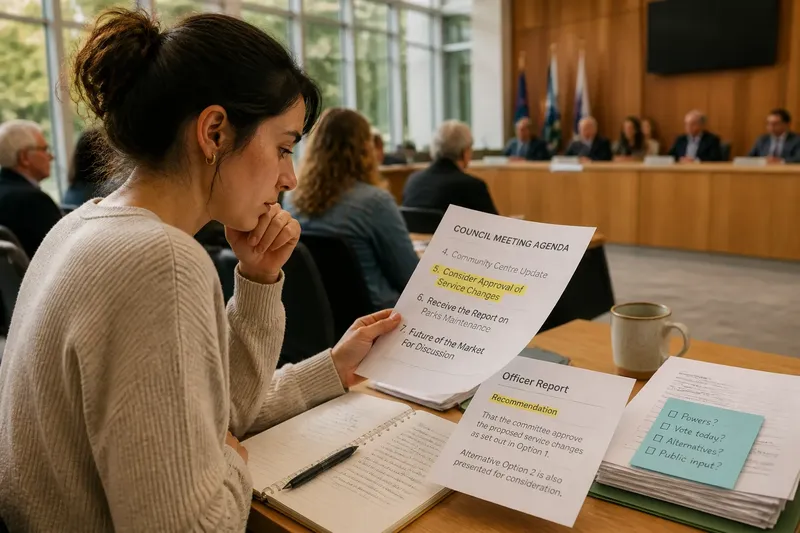
A public agenda can say “discussion of the proposed library hours” while the meeting is set to approve a change that afternoon. Agenda wording matters because it tells residents what officials may do, what they are merely considering and what they may already have decided elsewhere. To understand the real decision, read the item as a question about authority: who can act, what action is available and what choice is being requested now?
The challenge is not simply that agendas use official language. A phrase such as “receive the report” may mean no decision is scheduled, while “consider approval” may put a concrete choice before the body. But wording can also blur those distinctions. Comparing the agenda title with its supporting papers and the meeting’s rules gives you a better basis for deciding whether to attend, comment or ask for clarification.
Agenda wording can make different decisions sound alike
Meeting lists are compressed by design. They may name a topic, document or programme without stating the action members are expected to take. “Community centre update” could introduce information, invite views or precede a vote on funding. The heading alone does not tell you which one.
Look for the verb. Words such as “receive,” “note” and “discuss” often describe an information-sharing or exploratory stage. “Recommend,” “authorise,” “adopt,” “approve” and “amend” point towards a formal action. None is conclusive in every institution, but each gives you a useful clue about the item’s purpose.
Then ask what the verb operates on. “Approve the minutes” is not the same as “approve the revised parking plan”. “Consider the report” can describe a discussion without a decision, or it can be a procedural lead-in to a vote. The object of the action, along with the papers, matters as much as the verb.
Some headings sound open-ended even when the options are narrow. “Future of the market” might be followed by a recommendation to close it, extend its lease or transfer its management. Other headings sound decisive while leaving the actual choice unclear: “Approval of service changes” does not tell you what changes are proposed or whether members can amend them.
Three ways to read a decision hidden in an agenda
There are three useful approaches. They are not rival theories; each suits a different situation. Start with the one that matches how much time you have and how consequential the item seems.
Read the agenda title for the action verb
This is the quickest approach and suits someone scanning a long meeting list to decide which items deserve attention. Mark the verbs that indicate a possible exercise of authority: approve, adopt, appoint, authorise, revoke or recommend. Treat softer verbs such as “discuss” or “update” as prompts to inspect further, rather than proof that no decision will follow.
A title may combine stages: “Review and approval of the transport plan”. That wording suggests both scrutiny and a possible decision, but it does not show whether approval is expected at this meeting or whether members can choose another option. Use the verb to identify the question, not to answer it.
Compare the heading with the report’s recommendation
This approach suits residents who want to know what officials are asking members to do. Find the report or officer paper linked to the agenda item, then read its recommendation or proposed resolution. The heading may be broad, while the recommendation states an action such as approving a preferred route or asking staff to return with options.
Check whether the paper presents alternatives, explains why one is preferred and identifies who would carry out the decision. If the recommendation says “note the findings” but the report also describes a preferred course, distinguish the formal request from the background argument. That difference can help you frame a precise question at the meeting.
Check the meeting’s powers and sequence
This is the most useful approach when an item has legal, financial or procedural consequences, or when the agenda is too vague to interpret confidently. Find out whether the body listed can make the decision, only advise another body, or must send the matter to a later meeting. The council’s standing orders, committee terms of reference or meeting guidance may explain the route.
Also check the sequence. A committee may recommend a course that a full council later approves; a board may hear public views before a separate authority acts. The agenda can therefore contain a real decision without containing the final decision. If the relevant powers depend on local rules or the institution’s formal documents, consult those materials or ask the clerk or meeting officer for clarification.
How can you tell what the body is being asked to decide?
Does “for discussion” mean there will be no vote?
Not necessarily. It may indicate that members are expected to exchange views, but the chair may still put a motion if the rules and agenda allow it. Check the report’s recommendation and any published motions, then ask the meeting officer whether a decision is scheduled.
What does “to note” usually mean on an agenda?
It commonly asks members to acknowledge information rather than approve a proposal. Still, read the full recommendation: a paper may ask the body to note a report and also endorse a next step. The exact wording of the proposed resolution is more informative than the heading alone.
Can a public meeting change an agenda item?
That depends on the body’s procedure and the stage the item has reached. Members may be able to amend a motion, defer it or refer it elsewhere, but they may also be limited to the published recommendation. Check the institution’s meeting rules instead of assuming that a discussion automatically allows every alternative.
What should you do if the agenda is unclear?
Ask a specific question before the meeting: “Is the committee being asked to approve the proposal, recommend it, or discuss it without a decision?” You can also ask where the proposed resolution appears and whether public comment is accepted on that item. A focused query is easier to answer than a general complaint about the wording.
Choose your approach by the decision you need to understand
Use the title-first approach when you are screening the agenda quickly. It helps identify items that may involve a vote, appointment or change in policy. It is not enough when the title uses a vague noun, such as “review”, or when an important verb is missing.
Use the report-first approach when you need to understand the proposal itself. It suits a resident preparing a comment, because the recommendation gives you something concrete to address. If the report is unavailable, incomplete or difficult to interpret, ask the meeting officer whether there is a draft resolution or supporting paper.
Use the powers-and-sequence approach when you need to know who can make the final choice. It is especially helpful when a committee, advisory group and full council all appear in the process. It takes more checking, but prevents you from mistaking a recommendation for a binding decision—or assuming that a vote has no effect because another stage follows.
Say you see “Riverside path options” on a committee agenda. The heading does not say whether members will choose a route. You open the attached report and find a recommendation to select the western route, then check the committee’s terms and see that it can only advise the council. You can now ask whether the committee will vote on that recommendation and which council meeting will consider the final choice.
For a quick decision, ask yourself: “What wording would appear in the minutes if this item passes?” If you cannot imagine a clear answer, the agenda may be describing a topic rather than the action. That is a reason to check the report or ask for the proposed resolution, not a reason to assume the item is harmless or settled.
A clear question can expose a vague agenda
When contacting the clerk, committee secretary or public information office, quote the item’s title and ask what members are being asked to do at that meeting. Request the recommendation or motion in plain language, and ask whether the body can amend, defer or only recommend it. This keeps your enquiry focused on the decision rather than on whether the agenda sounds confusing.
If you plan to speak, tailor your comment to the actual stage. For an information item, you might ask what evidence or options will inform a later proposal. For a recommendation, explain which option you support and why. For a final approval, address the choice before members and any practical consequences they are empowered to consider.
Public papers can also reveal what remains undecided. Look for phrases such as “subject to consultation”, “further approval required” or “officers to report back”. These can mark a real boundary: a meeting may settle one issue while leaving another open. Keep those boundaries in view so your question reaches the decision-makers who can act on it.
The agenda wording method is simple: identify the action verb, read the recommendation, then confirm the body’s authority and the next stage. Use the first when time is short, the second when preparing a response, and the third when the decision’s status matters. If the papers still do not state what members may decide, ask for that answer before treating the item as settled.
One useful habit is to save the agenda and report together when a decision affects your neighbourhood. If the minutes later use different wording, you can compare the published request with the recorded action and see whether the body approved, amended, deferred or merely noted the proposal. That record makes future public questions more precise.